We’ve spent the last few decades making machines increasingly intelligent. We optimized for computation, recognition, prediction, and reasoning – and for the most part, that intelligence lived safely behind a predictable screen.
Physical AI changes everything. The moment intelligence leaves the screen, it has to deal with the physical world. And the physical world is not clean: bodies move, skin stretches, people sweat, temperatures change, and materials fatigue.

Why Physical AI Demands a New Interface Paradigm
When AI was digital, the interface was defined around the machine. Physical AI forces us to do the opposite: we have to design around the environment, and ultimately around the human.
- The Multidimensional Challenge
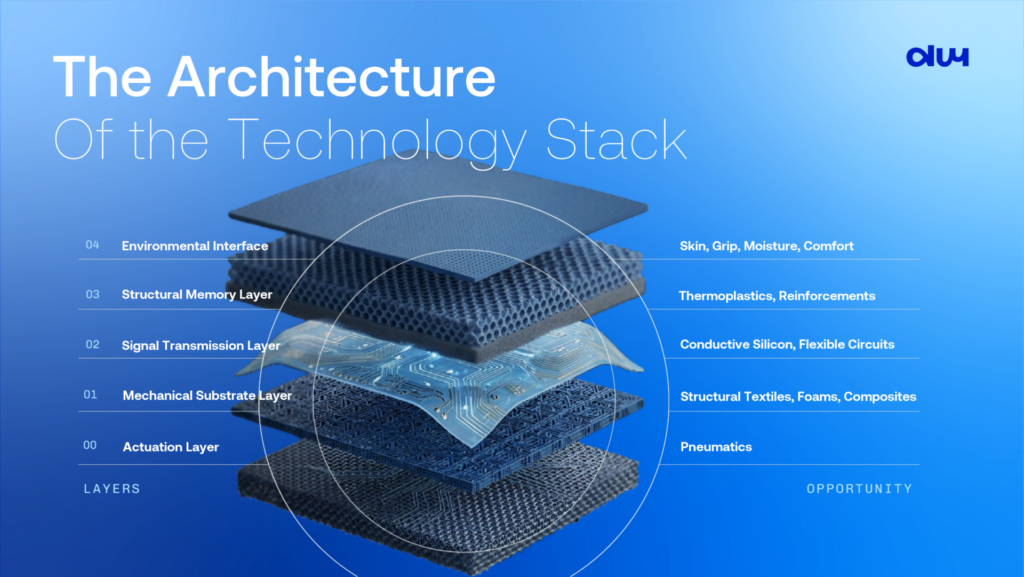
A robot doesn’t just need to know what a user is doing; it needs to understand positioning, gait, force application, and dynamic movement. A wearable must collect stable signals while walking, sweating, and sleeping. An exoskeleton must generate and transfer force safely into the body. - The Architecture of Materials
These aren’t isolated engineering hurdles. The mechanical layer has to work with the sensing layer, the sensing layer with the material, and the material with the body. They must operate as a unified system.
Defining the “Soft Interface”
To solve this, we have to look beyond single breakthrough materials and focus on composite material stacks. We define a soft interface not simply by what it’s made of, but by its behavior:
- It accommodates the physical world rather than forcing the physical world to accommodate the machine.
- It can move, deform, and manage moisture and heat.
- It transmits signals and distributes force seamlessly while in motion.
Ultimately, the best interface is the one you don’t have to think about. As AI becomes physical, the interface becomes the relationship itself – determining how comfort, trust, and force transfer intersect. Intelligence only becomes truly useful when it can successfully enter the physical world without asking the human to change.
Tiasha Renganathan
CEO and Co-Founder
Differentworks